The tactical gravity of the NRG Stadium was centered on a single, high-stakes question: could Brazil survive the inauguration of the 2026 knockout phase without succumbing to their own history? With 68,777 fans creating a pressure-cooker environment in Houston, this Round of 32 clash arrived burdened by the weight of 14 previous meetings and a hauntingly fresh scar. While Brazil entered as technical favorites under Carlo Ancelotti, the pre-match narrative was dominated by the 2025 Kirin Challenge Cup, where Hajime Moriyasu’s Japan side had tasted blood in a 3-2 comeback victory. This wasn't a standard David vs. Goliath fixture; it was a confrontation between a South American giant searching for structural identity and an Asian powerhouse that had finally stopped fearing the yellow shirt.
The Samurai Blue’s Calculated Ambush (The First Half)
Moriyasu’s opening gambit was a masterclass in low-block elasticity. By deploying a compact five-man defensive line, Japan effectively neutralized Brazil’s half-space runners, leaving Vinícius Júnior and Matheus Cunha isolated against a wall of blue. Japan’s discipline ensured that Brazil’s possession remained horizontal and harmless, waiting for the inevitable fracture in the Seleção’s rest defense.
That fracture occurred in the 29th minute. Danilo Luiz, under minimal duress, committed the cardinal sin of an under-hit pass into a congested central zone. Kaishu Sano pounced with clinical aggression, intercepting the ball and embarking on a 50-yard solo surge that exploited Brazil’s fragmented transition. Sano ignored the decoy runs and unleashed a low, right-footed drive from outside the area; the ball skipped across the Houston turf and nested into the bottom left corner. For the remainder of the half, Brazil looked structurally paralyzed.
Technical superiority is a hollow metric when confronted with Japan’s 5-4-1 defensive geometry. In the opening 45 minutes, Brazil’s "dominance" was an illusion. By sitting in a deep block, Japan didn't just defend; they dictated where Brazil could play. Vinícius and Cunha were denied receiving the ball on the half-turn, forced instead to face a double-team every time they touched the leather. Organization beats flair when the flair lacks the verticality to stress the defensive lines, and Sano’s goal was the direct result of a team mistaking possession for control.
Ancelotti’s "Mind, Heart, and Clarity": The Tactical Pivot
The interval demanded a psychological reset. Carlo Ancelotti, ever the pragmatist, reportedly bypassed tactical histrionics in favor of a stabilizing mantra: "mind, heart, and clarity." The adjustments were surgical. The introduction of the teenage sensation Endrick at the half provided a focal point for verticality, while Ancelotti instructed his center-backs to act as auxiliary playmakers to bypass Japan’s tired midfield screen.
The shift in tempo was immediate. Brazil moved from stagnant recycling to a high-pressure siege, pinning Japan into their own final third. The critical window between the 46th and 55th minutes redefined the match’s trajectory:
- 48th Minute: Danilo Luiz picks up a tactical yellow card, signaling a more aggressive Brazilian approach to stopping Japanese counters at the source.
- 52nd Minute: Zion Suzuki produces a world-class fingertip save to deny Vinícius Júnior, turning the ball onto the post after a rapid Brazilian combination.
- 55th Minute: Gabriel Magalhães begins pushing into the left channel, assuming the playmaking duties usually reserved for a deep-lying midfielder.
The Veteran’s Response: Casemiro’s Equalizer
When a low block remains stubborn, elite sides stop trying to play through and start playing over. In the 56th minute, Brazil found their breakthrough via the "Arsenal connection." Gabriel Magalhães, utilizing the ball-playing range developed in North London’s high-line system, delivered an inch-perfect cross from the left flank.
Casemiro, who had appeared cumbersome and sluggish in the first half—notably being bypassed by Sano during the opening goal—showed why he remains Ancelotti’s "old warhorse." Fired up after the break, the midfielder ghosted to the back post to meet Gabriel’s delivery with a thumping header that gave Suzuki no chance. The goal made Casemiro the second-oldest World Cup goalscorer in Brazil’s storied history. Despite his physical struggles earlier in the match, his leadership during this period earned him Man of the Match honors as he anchored a frantic second-half performance.
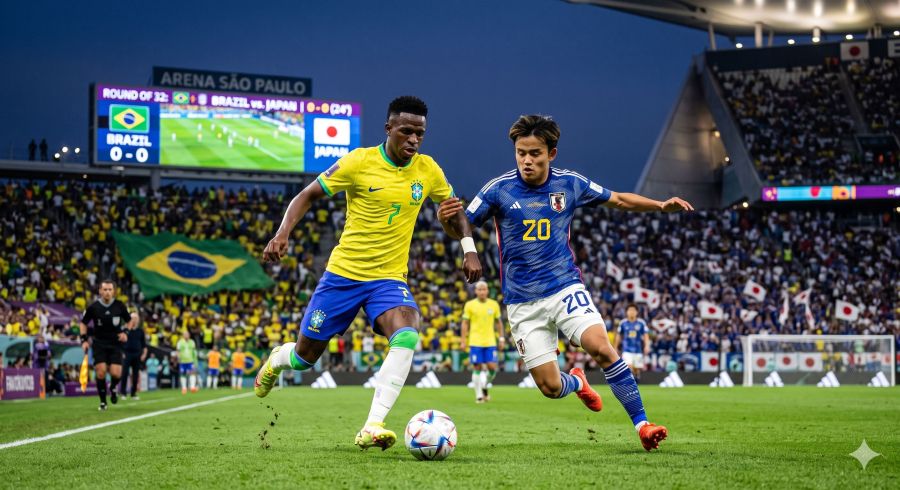
The Martinelli Miracle: A Stoppage Time Dagger
As the clock bled into stoppage time, the strategic value of bench depth became the ultimate differentiator. Ancelotti notably kept Neymar on the bench, a high-stakes gamble intended to preserve the team's defensive structure for a potential 30 minutes of extra time.
In the 90+5 minute, the gamble was vindicated. Bruno Guimarães, showing immense composure under the Houston lights, threaded a needle-sharp low pass into the left side of the area. Gabriel Martinelli, who had replaced Cunha in the 66th minute, took a clinical first touch before firing a right-footed strike that clipped the post and settled into the net. The stadium dissolved into "Samba bedlam" as the late dagger secured the 2-1 victory.
Post-match, an emotional Martinelli revealed the internal monologue behind the winner. "After hitting the woodwork earlier in the half, I knew I’d get another chance," he told reporters. The Arsenal forward cited the "joy in his heart" at seeing his parents in the stands, a human element that seemed to fuel his relentless energy in the final ten minutes.
For Japan, the result solidified a haunting "knockout curse." This was the third consecutive World Cup (following 2018 against Belgium and 2022 against Croatia) where the Samurai Blue led in a knockout match only to be sent home.
Final Match Constat and Tactical Legacy
Brazil’s quest for a sixth star moves to the Round of 16, but the takeaway from Houston is the evolution of their "structural integrity." This was a win authored by the "Arsenal duo" of Gabriel and Martinelli rather than individual brilliance from the old guard. Japan bows out with immense pride; they proved that the gap between the world's elite and Asian football is now razor-thin, even if the psychological hurdle of the knockout round remains.
Ancelotti’s decision to withhold Neymar until the 105th minute—a plan rendered unnecessary by Martinelli—showed a manager who trusts his system over his superstars. By refusing to "change the structure" while his team was outperforming a tiring Japanese block, Ancelotti proved that this Brazil is built for the marathon of a tournament, not just the sprint of a highlight reel.
Match Analytics and Personnel Data
Match Statistics: Brazil vs. Japan
Category | Data |
Scoreline | Brazil 2–1 Japan |
Attendance | 68,777 |
Man of the Match | Casemiro (Brazil) |
Yellow Cards | Brazil 3 (Casemiro, Danilo, Guimarães), Japan 4 (Sano, Kamada, S. Suzuki, Taniguchi) |
Confirmed Lineups
Brazil (Manager: Carlo Ancelotti)
- GK: Alisson
- DEF: Danilo Luiz, Marquinhos (c), Gabriel Magalhães, Douglas Santos
- MID: Casemiro (Sub: Fabinho 90+3'), Bruno Guimarães, Lucas Paquetá (Sub: Endrick 46')
- FWD: Rayan, Matheus Cunha (Sub: Gabriel Martinelli 66'), Vinícius Júnior
Japan (Manager: Hajime Moriyasu)
- GK: Zion Suzuki
- DEF: Takehiro Tomiyasu, Shōgo Taniguchi, Hiroki Itō
- MID: Ritsu Dōan (c) (Sub: Y. Sugawara 66'), Kaishū Sano, Daichi Kamada (Sub: A. Tanaka 78'), Keito Nakamura (Sub: J. Suzuki 66')
- FWD: Junya Itō (Sub: S. Machino 78'), Ayase Ueda, Daizen Maeda (Sub: K. Ogawa 90+7')
