When people think of the FIFA World Cup, it is hard not to think of Brazil. Few teams have shaped the tournament’s identity so completely, from unforgettable champions to a football culture that has influenced how the game is played, watched, and celebrated around the world.
Brazil’s World Cup story is not just about trophies. It is about creating a recognizable style, producing iconic players, and building a legacy that continues to motivate new generations. From the first World Cup in 1930 to the modern era, Brazil has consistently been a benchmark for ambition, talent development, and high expectations.
Brazil’s World Cup foundation: How it started
Brazil took part in the very first FIFA World Cup in 1930, immediately placing itself among the pioneering nations of the international game. The early tournaments were a proving ground: long travel, different playing conditions, and rapidly evolving tactics made each edition an intense test of adaptability.
Even before the titles arrived, Brazil’s participation helped build the country’s football identity on the world stage. These early experiences set the tone for what would become a defining national project: developing elite players and competing at the highest level, every time.
A unique mark of consistency
Brazil is widely recognized for an unmatched level of World Cup continuity. It is the only national team to have participated in every FIFA World Cup edition, reinforcing its reputation as one of the sport’s most reliable top-tier powers.
This consistency has real benefits beyond prestige:
- Long-term player development becomes a national priority, because World Cup participation is treated as non-negotiable.
- Institutional experience accumulates over decades, improving preparation, scouting, and tournament management.
- Global visibility stays high across generations, supporting Brazil’s influence on football culture worldwide.
The first great turning point: Hosting in 1950
Brazil hosted the FIFA World Cup in 1950, a landmark moment for both the tournament and the country. The event showcased Brazil’s passion for the game and its ability to stage football on a massive scale. The tournament is often remembered for its emotional intensity and for the way it amplified the importance of the World Cup in Brazil’s national life.
While the sporting outcome did not produce a title for Brazil that year, the broader impact was significant: the 1950 World Cup strengthened Brazil’s football infrastructure, deepened the country’s connection to the tournament, and fueled a powerful determination to return stronger.
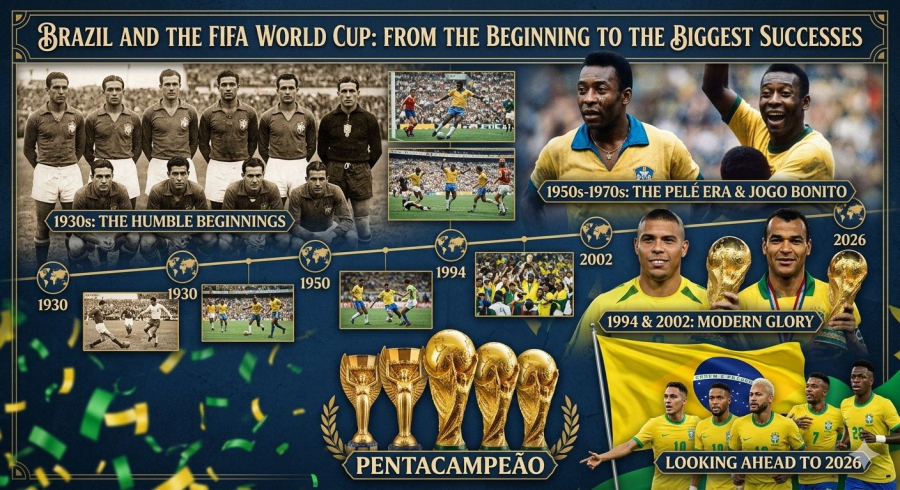
Brazil’s biggest successes: The five World Cup titles
Brazil stands alone as the most successful men’s national team in FIFA World Cup history, with five titles. Each championship reflects a different era of excellence, from the rise of global superstars to disciplined tournament mastery.
World Cup title overview
| Year | Host country | Final opponent | Final score | What made it special |
|---|---|---|---|---|
| 1958 | Sweden | Sweden | 5–2 | Brazil’s first title and the arrival of Pelé on the biggest stage. |
| 1962 | Chile | Czechoslovakia | 3–1 | Depth and brilliance, with Garrincha playing a central role. |
| 1970 | Mexico | Italy | 4–1 | Often celebrated as one of the most iconic teams in World Cup history. |
| 1994 | United States | Italy | 0–0 (3–2 on penalties) | Elite tournament control and defensive balance, ending a 24-year wait. |
| 2002 | South Korea & Japan | Germany | 2–0 | Ronaldo’s comeback and a complete, attack-minded squad. |
1958: The first crown and a global breakthrough
Brazil’s first World Cup win in 1958 was a defining milestone. It marked the moment Brazil shifted from a respected contender to a true world champion, turning talent into a winning formula under the highest pressure.
That tournament is also widely associated with the rise of Pelé, whose impact symbolized a broader Brazilian strength: producing players capable of performing brilliantly on the sport’s biggest stage.
Benefits of the 1958 triumph included:
- International recognition of Brazil as a football superpower.
- A clear national identity built around creativity, confidence, and attacking intent.
- Inspiration for youth, accelerating the dream of World Cup greatness across generations.
1962: Winning again with depth and resilience
Retaining the World Cup in 1962 confirmed that Brazil’s success was not a one-time peak. Winning back-to-back titles requires more than star power: it demands squad depth, tactical flexibility, and composure in decisive moments.
This title is closely linked with the brilliance of Garrincha, a player celebrated for his dribbling and match-winning influence. The 1962 win reinforced Brazil’s reputation for producing unique talent while maintaining the team structure needed to go all the way.
1970: A team that became football history
The 1970 World Cup in Mexico is often seen as a high point not only for Brazil, but for the World Cup itself. Brazil’s team is widely admired for its attacking cohesion, technical skill, and memorable goals, winning the final 4–1 against Italy.
For many fans, 1970 represents the clearest expression of jogo bonito, a phrase associated with beauty, joy, and creativity in Brazilian football. Importantly, the team’s impact extended beyond results: it helped shape how football is imagined and marketed globally.
Why the 1970 win still matters
- Global influence: It set a lasting standard for entertaining, effective attacking play.
- Brand power: Brazil’s yellow shirt and expressive style became globally recognizable symbols.
- Legacy building: It strengthened Brazil’s position as a reference point for great teams.
1994: A modern champion built on balance
Brazil’s 1994 victory in the United States showed a different kind of excellence: control, discipline, and game management across a long tournament. The final against Italy ended 0–0, with Brazil winning on penalties.
This championship highlighted an important truth about enduring success: great teams adapt. Brazil demonstrated that it could combine its traditional skill and flair with a more pragmatic, results-focused approach when the tournament demanded it.
In 1994, Brazil also celebrated the impact of stars such as Romário, whose performances helped define the campaign.
2002: Ronaldo’s comeback and a fifth star
In 2002, Brazil captured its fifth World Cup title, defeating Germany 2–0 in the final. This tournament is especially remembered for Ronaldo and his high-profile return to the very top of world football.
Beyond the headlines, the 2002 win showcased Brazil’s strength in building squads with both individual brilliance and team functionality. The team combined attacking talent with the structure needed to navigate knockout football, delivering a championship that reinforced Brazil’s position at the top of the sport.
What the 2002 title reinforced about Brazil
- Elite talent pipelines can recover, reload, and produce new winning generations.
- Big-game confidence remains a competitive advantage in decisive matches.
- Global admiration grows when style and results arrive together.
Legends who shaped Brazil’s World Cup identity
Brazil’s World Cup history is inseparable from its legendary players. While football is always a team sport, Brazil has repeatedly produced individuals who elevate the team’s ceiling and transform matches.
Among the most iconic names strongly associated with Brazil’s World Cup legacy are:
- Pelé (notably linked with 1958 and 1970), a defining figure in global football history.
- Garrincha, celebrated for his impact in the early 1960s and his unique dribbling style.
- Jairzinho, remembered as a key figure in the 1970 team’s attacking force.
- Romário, a leading figure in the 1994 triumph.
- Ronaldo, the face of Brazil’s 2002 victory and one of the era’s standout finishers.
These players helped Brazil achieve something that is rare in sport: a long-term identity that stays recognizable even as tactics and eras change.
More than titles: Brazil’s World Cup impact on culture and football
Brazil’s World Cup influence goes far beyond match results. The team’s style and storytelling have helped define how fans experience the tournament itself. For many viewers, Brazil represents what makes the World Cup special: creativity, personality, and moments of brilliance that feel larger than the scoreboard.
Key positive impacts of Brazil’s World Cup legacy
- Youth inspiration: World Cup heroes become role models, driving participation and ambition.
- Football education: Brazil’s best teams are studied for movement, technique, and attacking combinations.
- Global cultural reach: Brazil’s World Cup presence reinforces the connection between football, music, celebration, and national identity.
Hosting again in 2014: A modern World Cup moment
Brazil hosted the FIFA World Cup again in 2014, bringing the tournament back to one of its most iconic football countries. Hosting delivered major global attention, unforgettable fan atmosphere, and a renewed spotlight on Brazilian football culture.
On the sporting side, 2014 also became a moment that tested Brazil’s resilience and prompted reflection and rebuilding. In elite sport, these moments can become catalysts, sharpening long-term development and reinforcing the drive to return stronger.
Why Brazil remains a World Cup favorite in every era
Even in years when Brazil does not lift the trophy, it typically enters the World Cup among the most discussed and feared teams. That status is not based on nostalgia alone. It is built on a combination of history, talent production, and the expectation of performance under pressure.
Core strengths that keep Brazil in the conversation
- Deep talent pools across generations, especially in attacking positions.
- Technical quality that can decide tight matches with a single moment.
- World Cup experience built through continuous participation and high expectations.
- A winning blueprint proven across different eras, styles, and tournament formats.
Takeaway: Brazil’s World Cup story is the tournament’s story
From joining the first World Cup to becoming the only five-time champion, Brazil’s journey is one of football’s greatest long-term success stories. The highlights are not only the trophies in 1958, 1962, 1970, 1994, and 2002, but also the enduring influence on how the World Cup feels: colorful, creative, dramatic, and global.
Brazil’s greatest achievement may be this: its World Cup history consistently turns matches into memories and players into legends, ensuring that every new tournament still carries the possibility of another unforgettable Brazilian chapter.
