Brazil never travels to a World Cup with small ambitions. The expectation is always the same: play with personality, compete with authority, and arrive in the final rounds with a squad deep enough to solve any problem a tournament can throw at you. For 2026, the exciting story is not just about individual stars. It is about how Brazil can connect its best talent into a coherent, modern plan while preserving the joy and daring that make the shirt feel different.
This article is a forward-looking, factual guide to what Brazil’s 2026 World Cup team could look like: the likely pillars, the roster battles, and the “new golden thread” that ties together flair, athleticism, and tactical clarity. Because the final squad and even the competitive landscape can change quickly, think of this as a map of the strongest options and the most persuasive blueprint, rather than a definitive list.
The 2026 opportunity: depth, versatility, and a new generation arriving on time
Brazil’s player pool heading into 2026 offers three major advantages that matter specifically in World Cup football:
- Elite attackers in their prime who can win one-on-one matchups and decide tight games.
- A growing midfield engine built around ball-winning, tempo control, and the stamina to press and recover repeatedly.
- Center-back and goalkeeper quality at the top end, giving Brazil a stable platform even on days when finishing is not flowing.
The biggest benefit is flexibility. In modern tournaments, the best teams rarely play one fixed style for seven matches. They shift between patient possession, fast transitions, and game-state management. Brazil’s 2026 build can be tailored to opponents without losing its identity.
The “new golden thread”: what Brazil can be known for in 2026
When people talk about Brazil, they often default to tradition: skill, improvisation, and attacking talent. Those qualities remain real, but 2026 success is most likely if Brazil’s identity is defined by a modern “golden thread” that runs through every line of the team.
1) 1v1 brilliance, but with structure around it
Brazil’s wide attackers are at their best when they receive the ball in advantageous spaces, with nearby support and clear rest-defense behind them. That means building a system where dribblers do not have to create everything alone. The benefit: more high-quality chances, fewer low-percentage hero plays.
2) Aggressive counter-pressing after losses
Many of the world’s most effective teams protect themselves by reacting instantly when possession is lost. Brazil has the athletic tools to do this, and the payoff is huge: fewer opponent transitions, more attacking possessions in advanced areas, and more shots created from disorganized defenses.
3) A midfield that can run and think
World Cups are won in the midfield details: second balls, covering fullbacks, stopping counters before they grow, and turning a chaotic match into a controlled one. Brazil’s 2026 potential looks strongest when the midfield combines intensity with calm decision-making.
4) Match winners in multiple positions
In knockout football, a single moment can decide everything. The advantage for Brazil is having match-winners not only in the front three, but also in goal, at center-back, and in midfield. That diversity of “deciders” increases the number of ways Brazil can win.
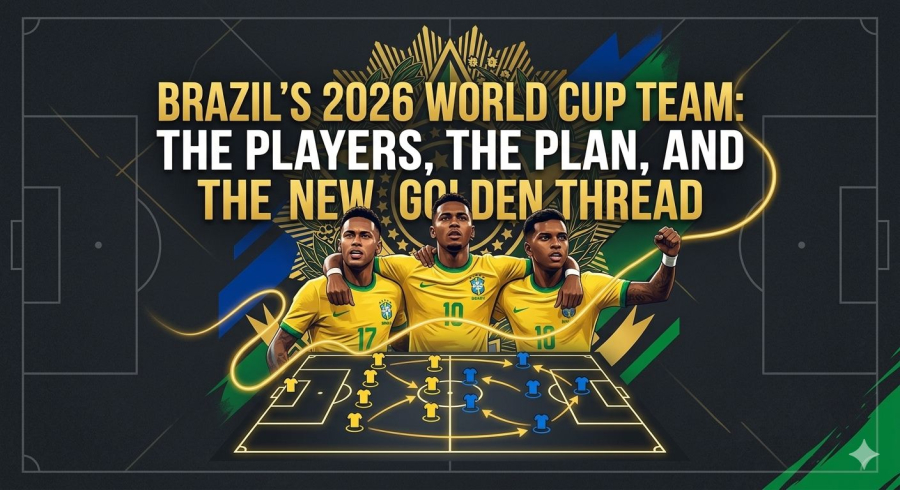
The plan: a 2026 blueprint that travels well
A persuasive World Cup plan is not just a formation on paper. It is a set of principles that survive fatigue, travel, weather, and the psychological pressure of elimination matches. Here is a blueprint that fits Brazil’s strengths and the demands of 2026.
Principle A: Build a stable spine first
Brazil’s most reliable tournament teams typically have a clear spine: goalkeeper, center-backs, central midfield, and a primary goal threat. Once that is settled, the creative pieces can rotate around it. The benefit is consistency in defensive communication and build-up patterns, even as wingers and fullbacks vary by opponent.
Principle B: Two-way fullbacks, not just runners
Modern fullbacks must solve multiple tasks: provide width, invert into midfield when needed, and defend large spaces in transition. Brazil’s plan benefits when fullbacks are chosen not only for speed, but also for decision-making and positioning. That reduces the “open-field” defending situations that even elite teams hate.
Principle C: Pick complementary attackers, not just famous names
Brazil’s depth is a gift, but it also creates selection pressure. A forward line works best when roles complement each other: one attacker stretching depth, one arriving at the far post, one dropping to connect, and at least one relentless presser. The benefit is collective efficiency: more chances created with fewer touches and less risk.
Principle D: Tournament management as a competitive edge
In 2026, recovery and rotation will matter. Brazil’s advantage can come from using its bench as a weapon: planned minutes for key players, fresh legs to protect leads, and targeted substitutions to change matchups.
The player pool: building blocks and high-upside options
Brazil’s final 2026 squad will depend on form, fitness, and coaching preferences. Still, certain profiles stand out as especially valuable for a World Cup run. Below is a structured view of key roles and plausible candidates from Brazil’s recent and emerging pool.
Core roles and candidates (projection, not a final squad)
| Role | What the role must deliver | Leading candidates / strong options |
|---|---|---|
| Goalkeeper (starter caliber) | Shot-stopping, calm distribution, command of box | Alisson, Ederson, Bento |
| Center-back leaders | Duels, line control, build-up quality, recovery pace | Marquinhos, Éder Militão, Gabriel Magalhães, Bremer |
| Fullbacks / wide defenders | Width, transition defense, positional intelligence | Danilo, Yan Couto, Caio Henrique, Renan Lodi |
| Midfield anchor | Ball-winning, covering space, simple progression | Bruno Guimarães, João Gomes |
| Box-to-box midfielder | Runs, pressing, arriving in the box, tempo changes | Douglas Luiz, Bruno Guimarães, Joelinton |
| Creative connector | Final-third passing, combination play, set-piece threat | Creative midfield options vary by form and coach preference |
| Left-sided star winger | 1v1 creation, chance generation, big-game moments | Vinícius Júnior |
| Right-sided attacker | Goals, combination play, pressing, flexible positioning | Rodrygo, Raphinha, Gabriel Martinelli (as an option across the front) |
| Striker / finishing focus | Penalty-box presence, movement, conversion under pressure | Endrick, Richarlison, Gabriel Jesus |
The table highlights a key 2026 advantage: Brazil can build multiple “good” versions of the team without falling off a cliff in quality. That allows tactical tailoring, which is a major edge in a one-month tournament.
The headline talents: how Brazil can get the best from its stars
Vinícius Júnior: the gravity that reshapes defenses
At club level, Vinícius Júnior has shown that elite pace, improved decision-making, and relentless attacking intent can bend a defense even before the ball arrives. For Brazil, the biggest benefit comes when the team creates repeatable situations where he receives:
- Isolated against a fullback, with space to accelerate.
- In the left half-space, with a runner outside to drag the defender.
- In transition, with early service and support near the box.
The “new golden thread” approach helps him most when there is structure behind the dribble: midfield coverage, immediate counter-pressing, and a clear far-post target. That turns individual brilliance into consistent chance volume.
Rodrygo: the flexible match-winner
Rodrygo’s tournament value is amplified by his versatility. He can play as a right winger, drift inside as a connector, or operate closer to goal. In a World Cup, that flexibility is priceless because it allows Brazil to:
- Change shape without substituting.
- Exploit a weak opponent fullback by shifting matchups.
- Add an extra midfielder in buildup while still keeping goal threat.
In an upbeat 2026 scenario, Rodrygo becomes the glue that keeps Brazil dangerous even when the opponent overloads Vinícius Júnior’s side.
Endrick: high-upside finishing and intensity
Endrick represents the kind of young, high-ceiling attacker who can change the emotional temperature of a squad: fearless runs, explosive strikes, and a mentality that does not wait for permission. For 2026, the smart plan is to build clear, simple striker tasks around him if he is selected:
- Attack the near post with conviction.
- Make the depth runs that open space for creators.
- Lead the first wave of pressure to force rushed clearances.
In tournament terms, that profile can be a difference-maker, especially when matches become tight and chances are scarce.
The veteran factor: leadership and calm if the moment calls for it
Brazil has historically benefited from experienced leaders who manage game moments: slowing a match, drawing fouls, choosing when to accelerate. In 2026, any veteran presence (whether in attack, defense, or midfield) becomes most valuable when it supports the “golden thread” rather than replacing it: leadership that amplifies intensity, discipline, and collective confidence.
The engine room: why midfield balance can be Brazil’s competitive edge
If Brazil’s attack is the headline, the midfield is the infrastructure. The best international midfields do three things repeatedly: protect the defense, progress the ball under pressure, and arrive in the box at the right time.
Bruno Guimarães: control plus bite
Bruno Guimarães profiles as a midfielder who can help Brazil play with authority. The benefits he can bring in a World Cup setting include:
- Tempo control through smart positioning and passing.
- Defensive intensity in duels and second balls.
- Link play that gets attackers facing forward.
When Brazil plays with a stable midfield base, its wingers can take more risks, knowing the team is protected behind them.
João Gomes and other ball-winners: the transition insurance
A top-level ball-winner is often the quiet hero of tournament football. A player in this role reduces the number of dangerous opponent counters and allows Brazil to press higher. The practical payoff is simple: fewer emergency sprints for the center-backs, and more time spent attacking.
Box-to-box profiles: running power that creates extra attackers
Brazil’s most persuasive 2026 setups likely include at least one midfielder who can surge forward and arrive late into the penalty area. That arrival run is hard to track and can create high-quality shots without requiring extra dribbling. It also helps Brazil score in multiple ways, which is crucial when opponents commit to stopping the wingers.
The back line: turning defensive quality into attacking freedom
Brazil’s defensive talent is often discussed in terms of “solidity,” but the bigger benefit is freedom. When the team trusts its rest-defense and aerial dominance, the creative players can attack with fewer handbrakes.
Center-back depth: options for different opponent styles
Brazil’s center-back pool includes profiles suited to different match demands:
- Organizers who control the line and communicate constantly.
- Athletic stoppers who can defend big spaces in transition.
- Progressors who can break lines with passing and carry.
In a World Cup, that variety is a strength because opponents vary dramatically: some sit deep, some play direct, some press high. Brazil can pick the pairing that best reduces risk while enabling the planned style.
Goalkeeper strength: security that shows up in knockout moments
Top international goalkeepers change tournaments. Whether it is a one-on-one save, a claim under pressure, or calm distribution that relieves a press, the benefit is emotional and tactical: the team plays braver when it trusts the last line.
Preferred shapes: how Brazil can look without becoming predictable
Brazil’s best version in 2026 may not be tied to one formation. Instead, it can be tied to repeatable behaviors. Still, a few shapes naturally fit the player pool.
Option 1: 4-3-3 as the default platform
A 4-3-3 can maximize wing quality, keep midfield coverage, and provide natural pressing triggers. It also makes it easier to rotate attackers without changing the entire structure.
- Benefit: clear roles for wingers and fullbacks, with midfield support.
- Benefit: strong counter-pressing structure when the front three work together.
Option 2: 4-2-3-1 for extra control and a dedicated connector
Against low blocks, a 4-2-3-1 can provide an extra player between the lines and more sustained pressure around the box.
- Benefit: more combination play in central pockets.
- Benefit: two midfielders behind the ball to manage counters.
Option 3: 4-4-2 out of possession for compactness
Many teams defend in a 4-4-2 shape even if they attack in a different formation. Brazil can do this too, using one attacker to jump to the press and another to screen passing lanes.
- Benefit: predictable defensive distances and clearer pressing responsibilities.
The small details that win tournaments: set pieces, substitutions, and role clarity
Set pieces as a multiplier
World Cups routinely reward teams that treat set pieces as a core scoring and defending phase, not an afterthought. Brazil’s aerial talent at center-back and physical midfield profiles can translate into:
- More dangerous corners and second-ball shots.
- Greater security defending late leads.
- Clear routines that reduce randomness.
Substitutions that change matchups, not just energy
Brazil’s depth enables a powerful tournament strategy: using substitutes to create new problems for the opponent. That can mean introducing a more direct winger, a more physical midfielder, or a striker with a different movement profile.
The best teams do this proactively. Instead of waiting for trouble, they anticipate fatigue and adjust before momentum swings.
Role clarity: the hidden accelerator
International football has limited training time. A 2026 Brazil that thrives is likely one where players understand:
- Where the first pass goes under pressure.
- Who protects the fullback when he advances.
- Who attacks the far post when the winger dribbles.
- Who leads the counter-press when the ball is lost.
Role clarity turns talent into consistency, and consistency is what carries teams through the unpredictable middle matches of a tournament.
A persuasive 2026 story: how the “new golden thread” can feel on the pitch
Picture Brazil in 2026 playing with a recognizable rhythm:
- The back line builds calmly, not rushed, inviting pressure and then playing through it.
- The midfield wins second balls and keeps the team in the opponent’s half.
- The left winger receives with space, supported by an overlapping or underlapping run.
- The far-side attacker arrives on time for cutbacks.
- When possession is lost, the reaction is immediate: two or three players press, the rest lock in behind them.
That is the “new golden thread” at its best: Brazil still expresses its traditional joy in the final third, but it is powered by modern habits that win tournaments.
What to watch as 2026 approaches
If you want to track whether Brazil is on the most promising path, focus on indicators that translate directly to World Cup success:
- Consistent midfield partnerships that balance ball-winning and progression.
- Defined attacking patterns that repeatedly create cutbacks and far-post chances.
- Improved rest-defense so counterattacks are slowed early.
- Bench impact with substitutes who change matches rather than simply fill minutes.
- Set-piece efficiency at both ends.
These signals are more reliable than any single friendly result because they reflect repeatable behaviors, not one-off moments.
Conclusion: Brazil’s 2026 promise is not just talent, but connection
Brazil will arrive to 2026 with enviable resources: world-class attackers, top-level goalkeeping options, and a defensive core capable of withstanding the highest pressure matches. The most exciting part is how well the pieces can fit together. If Brazil commits to a “new golden thread” built on structured support for its dribblers, intense counter-pressing, and a balanced midfield engine, the team can be both beautiful and brutally effective.
In other words, the opportunity for 2026 is clear: turn depth into adaptability, turn flair into repeatable chance creation, and turn the famous yellow shirt into a cohesive, modern tournament machine. That combination is exactly how World Cups are won.
