If you’ve come across a listing like “Brazil vs Morocco on 14/06 – World Cup”, it’s smart to pause before you plan your viewing schedule (or build any big expectations around a specific tournament match). The phrase looks official, but in many cases it reflects a mislabel, an unofficial calendar entry, or a generic tag used by third-party apps and social posts rather than a confirmed FIFA World Cup fixture.
This guide clears up what that label usually means, how to confirm what match is actually being referenced, and why, in a head-to-head meeting, Brazil would generally be favored based on long-term performance, squad depth, and tournament pedigree.
First: is “Brazil vs Morocco on 14/06” a real World Cup fixture?
In most situations, a post or listing that says “Brazil vs Morocco on 14/06 – World Cup” is not describing an official FIFA World Cup match.
Here’s the key context that helps you quickly sanity-check it:
- The FIFA Men’s World Cup is held every four years, and specific matchups (like Brazil vs Morocco) are only confirmed after the final draw places teams into groups and a complete match schedule is published.
- Seeing a specific matchup paired with a simple date like 14/06 (without a year, venue, city, kick-off time, or group designation) is a common sign of a generic or miscategorized entry.
- Brazil and Morocco can absolutely play each other, but that would typically be in a friendly, a tournament outside the World Cup, or a youth/club context, unless a World Cup draw actually puts them together.
Because match schedules and team qualification vary from cycle to cycle, the most accurate interpretation is: treat the “World Cup” label as unconfirmed until you verify it in an official competition schedule.
Why the date “14/06” often causes confusion
The date format 14/06 (June 14) shows up frequently in football content for a simple reason: it sits in a typical window when major international tournaments, qualifiers, and friendlies can occur. June is commonly used for international windows, and historically it has also been within the broader timeframe when World Cup tournaments are staged.
That makes it easy for a social post, a calendar widget, or a sports app to attach a “World Cup” label loosely—especially if the source is:
- A third-party database using broad categories like World Cup to mean “international football.”
- A content creator repurposing a thumbnail or caption that says “World Cup” for reach.
- A listing that mixes up Men’s World Cup with other competitions (women’s tournaments, youth competitions, futsal, or even esports).
- A prediction or “what-if” scenario presented without clear context.
The upside: once you know this pattern, you can avoid wasted time and focus on the matches that are truly scheduled and meaningful for your plans.
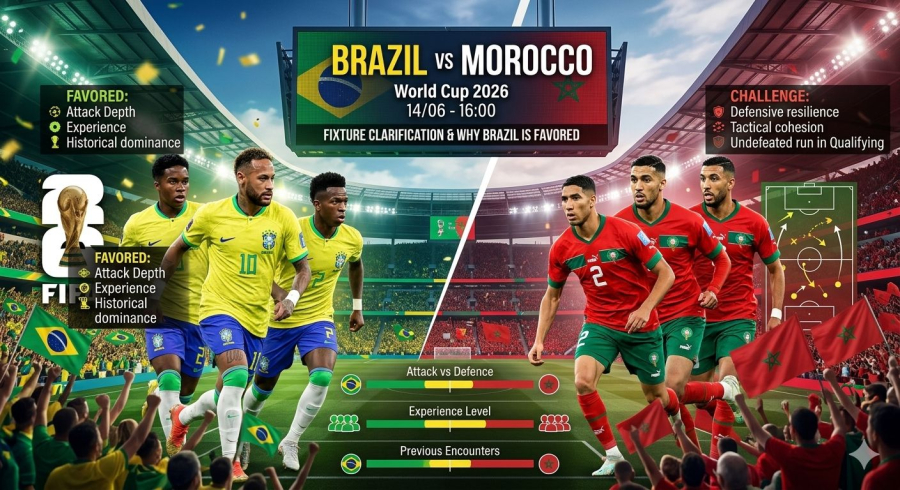
How to verify what “Brazil vs Morocco on 14/06” actually refers to
You don’t need insider info—just a structured check. Here’s a quick way to confirm the true nature of the fixture.
1) Look for the competition name beyond “World Cup”
An official match listing will normally specify a competition stage, such as Group details, Round of 16, or a clear tournament title. A vague “World Cup” label without a stage is often a placeholder.
2) Check whether a World Cup draw has already happened
A Brazil vs Morocco World Cup game can only be guaranteed after a draw places both teams in the same tournament bracket. If you’re seeing the matchup before a draw has taken place (or without referencing the draw), it’s not reliable.
3) Confirm whether the teams are in an official competition window
National teams play in defined windows (friendlies, qualifiers, Nations-type competitions, or tournament finals). If the date sits outside a recognized window, it raises the chance the listing is inaccurate.
4) Watch for missing match essentials
Legitimate fixtures typically include most of the following:
- Year (not just day/month)
- Kick-off time (with timezone)
- Stadium and city
- Competition organizer and stage
If the entry is missing several of these, treat it like content, not confirmation.
Common interpretations: what the listing might actually mean
Depending on where you saw it, “Brazil vs Morocco on 14/06 – World Cup” often falls into one of these categories:
| What you saw | What it often really is | Why it happens |
|---|---|---|
| “World Cup” with only a date | A generic international match label | Apps and posts sometimes tag international fixtures under broad terms |
| “Brazil vs Morocco” with no venue/time | A rumored or speculative matchup | Unofficial pages repost predictions or mock schedules |
| “World Cup” in a highlight clip title | A compilation or edited content | Creators use “World Cup” as a popularity keyword |
| A “World Cup” match listing before a draw | Not an official World Cup fixture | World Cup matchups cannot be fixed before the draw |
There can be a real Brazil vs Morocco match on a given date—just not necessarily a World Cup match. Once you verify the competition, you’ll know what level of significance to attach to it.
If Brazil and Morocco do play: why Brazil would typically be favored
Now to the part fans usually care about most: if Brazil and Morocco meet, why would Brazil be seen as the favorite?
It comes down to a few durable advantages that tend to matter in international football—especially against strong, well-organized opponents.
1) Tournament pedigree and high-pressure experience
Brazil’s national team is widely regarded as one of the most accomplished in men’s international football. Across decades of major tournaments, Brazil has built a reputation for handling:
- High-stakes knockout matches
- Deep tournament runs
- Pressure-heavy moments where a single chance changes the game
That kind of institutional experience is a competitive edge. It doesn’t guarantee a win, but it often translates into calmer decision-making when the match tightens.
2) Consistent access to elite attacking talent
Brazil’s biggest advantage is typically its ability to field multiple match-winners—players who can create goals from limited opportunities through:
- 1v1 dribbling and combination play
- Quick transitions
- Shots from distance and set-piece delivery quality
In international football, where defenses are often compact and chances are fewer, having more players who can produce a moment of quality is a major benefit.
3) Depth across positions
Morocco has developed into a highly competitive national team with strong structure and clear tactical identity. Even so, Brazil’s historical advantage has been the ability to replace starters with comparable quality. Depth matters because it helps with:
- Maintaining performance level if injuries occur
- Changing the game with substitutions
- Managing fatigue in tight international windows
That “second wave” quality is often what separates favorites from dangerous challengers.
4) Control of tempo and territory
Against well-drilled teams, Brazil often aims to dictate the match through controlled possession phases while still threatening quickly in transition. When that balance clicks, it can force opponents to defend longer stretches, increasing the chance of:
- Defensive lapses
- Late-match fatigue
- Set-piece concessions in dangerous areas
Even a disciplined side can struggle if it spends too much time absorbing pressure.
Respecting Morocco’s rise: why the matchup can still be compelling
Calling Brazil the favorite doesn’t mean Morocco should be treated as an afterthought. In recent years, Morocco has shown how far elite organization and belief can take a national team, including a landmark run to the semi-finals at the 2022 FIFA World Cup. That achievement alone signals a team that can compete with top opposition.
What makes Morocco a genuinely interesting opponent is the combination of:
- Strong team structure and tactical discipline
- Defensive resilience under pressure
- Confidence built from proven results on major stages
So if a Brazil vs Morocco fixture is real (whatever the competition), it’s the kind of matchup where Brazil’s talent advantage meets Morocco’s organization—a formula that often produces a high-quality, high-intensity game.
What would make Brazil more likely to win on the day
Favorites win not just by reputation, but by executing the right match plan. If Brazil were to play Morocco, these are the practical levers that typically increase Brazil’s win probability:
Quick, clean ball circulation
Disciplined defenses thrive on slowing the game down and forcing predictable attacks. Brazil benefits when it moves the ball sharply, switches play, and creates isolations for attackers without overdribbling into traffic.
Winning the transition moments
Many international games are decided in the “in-between” seconds right after possession changes. If Brazil can counter-press effectively and prevent clean Moroccan counters, the match tends to tilt Brazil’s way.
Set-piece sharpness
When open-play chances are limited, set pieces can decide the result. Brazil’s upside is having the delivery and aerial threats to turn corners and free kicks into real danger—especially if Morocco defends deep.
What fans gain by clarifying the fixture early
Getting the match context right is more than a technical detail—it improves your whole experience as a fan. When you confirm whether “Brazil vs Morocco on 14/06” is a World Cup match, a friendly, or simply a mislabeled post, you can:
- Plan viewing with confidence (and avoid last-minute confusion)
- Set expectations about intensity, lineups, and stakes
- Follow the right storyline, whether it’s tournament pressure or experimentation
- Enjoy the build-up with accurate information instead of rumors
That clarity also makes the football conversation better—because you’re reacting to what’s real, not what’s merely shareable.
Bottom line
A listing that reads “Brazil vs Morocco on 14/06 – World Cup” is often a misleading label unless it’s supported by an official competition schedule and a confirmed tournament draw. The best move is to verify the competition and match details before treating it as a World Cup fixture.
If Brazil and Morocco do play, Brazil would typically be favored thanks to a powerful mix of elite attacking options, depth, and high-pressure tournament experience. And with Morocco’s proven ability to compete at the highest level, the matchup remains a great watch—especially when you know exactly what’s at stake.
