A Brazil vs Morocco meeting at the 2026 FIFA World Cup would be one of the tournament’s most compelling matchups: a global giant with unmatched World Cup history against a modern, well-drilled side that has already proven it can upset elite opponents on the biggest stage.
This article is a pre-tournament style analysis rather than a recap of a confirmed fixture. With 2026 squads and matchups not guaranteed in advance, the goal here is to compare what each nation typically brings to a World Cup setting, using widely known historical context and recent tournament trends. If these teams do meet, the contrast in identity, depth, and experience could shape a fascinating 90 minutes.
At a Glance: Why This Matchup Matters
Brazil represent the sport’s most enduring World Cup brand: five-time champions, a pipeline of attacking talent, and a long tradition of adapting to different eras of football. Morocco, meanwhile, have evolved into a modern international force, highlighted by their historic run to the semi-finals at the 2022 World Cup, where they demonstrated defensive organization, tactical discipline, and genuine belief.
From a neutral perspective, the intrigue is clear:
- Brazil often win by forcing games into moments of individual quality and sustained attacking pressure.
- Morocco often win by controlling spaces, staying compact, and punishing mistakes with quick transitions.
Those identities can collide in a way that rewards small details: depth, substitutions, set pieces, and the ability to maintain concentration under pressure.
Key Differences Between Brazil and Morocco
1) Tournament Pedigree and Big-Moment Familiarity
One of Brazil’s biggest advantages is simply how often they have navigated World Cup pressure. Brazil are the only nation to have won the World Cup five times, and they’ve spent decades living with the expectation that anything short of a deep run is disappointment. That burden can be heavy, but it also creates a culture of preparation and a familiarity with high-stakes tournament moments.
Morocco’s World Cup history is smaller in volume, but their recent peak is extremely relevant. Morocco’s 2022 run was not a one-off lucky streak; it was built on structure, consistency, and well-executed game plans. For Morocco, that experience can now function as a confidence multiplier: they have proof that their approach works against elite opposition.
Why Brazil still edges it: over the course of a tournament, the teams with deep experience managing knockout-game stress and momentum swings often benefit. Brazil’s institutional knowledge and repeated exposure to these moments can matter, especially when a match turns on a handful of decisive situations.
2) Depth of Talent and Replacement Quality
International football often comes down to depth more than fans expect. In a World Cup, injuries, suspensions, fatigue, and tactical changes force teams to rely on their second and third options. Brazil typically have an advantage here because of the sheer scale of their elite player pool, especially across attacking positions and fullback roles.
Morocco’s best teams tend to be built on a highly cohesive core. That cohesion is a strength, but it can also make replacing specific roles more challenging if a key player is unavailable.
Why Brazil has the edge: if the game becomes stretched late, or if the match requires a plan B, Brazil are more likely to have multiple high-impact options to change tempo, add creativity, or raise the technical level without altering the team’s identity.
3) Attacking Variety vs Defensive Structure
Morocco have become known for their defensive organization: compact spacing between lines, committed tracking, and a clear understanding of when to press versus when to retreat. That clarity can frustrate even the most talented teams, because it reduces the number of clean looks at goal.
Brazil’s best versions typically offer multiple ways to score:
- Quick combinations around the box
- Wide overloads and 1v1 dribbling
- Late runs from midfield
- Set-piece threats
- Shots from distance when opponents sit deep
Against disciplined defenses, variety is a competitive advantage. It forces defenders to solve different problems over and over, which increases the chance of a single breakdown.
Why Brazil has the edge: Morocco can defend at a high level, but Brazil’s attacking range and ability to create chances from different patterns can eventually produce the one moment that breaks a tight match.
4) Game State Management: What Happens When Someone Scores First?
A decisive factor in a Brazil vs Morocco scenario is the first goal. Morocco are excellent when they can keep the game in their preferred shape: compact, controlled, and prepared to counter. If Morocco score first, their ability to protect a lead becomes a real weapon.
Brazil, however, are often well-equipped for different game states:
- When level: they can probe patiently while maintaining threat.
- When behind: they can increase attacking numbers and still keep quality on the pitch.
- When ahead: they can manage possession and force opponents to take risks.
Why Brazil has the edge: the broader the range of game states a team can handle without panic, the more likely they are to win close knockout matches. Brazil’s talent base helps them stay dangerous even when the script changes.
5) Individual Match-Winners
World Cup matches are often decided by moments, not minutes. A single dribble that breaks a line, a perfectly weighted through ball, a set-piece delivery, or a deflection can determine the outcome.
Morocco have top-level players and leaders who can swing moments, particularly in transition and defensive duels. Brazil, though, are historically one of the most reliable producers of pure match-winners: players capable of creating a goal from a situation that looks harmless.
Why Brazil has the edge: if the match becomes a tactical stalemate, the side with more players who can invent solutions against a set defense usually holds the advantage.
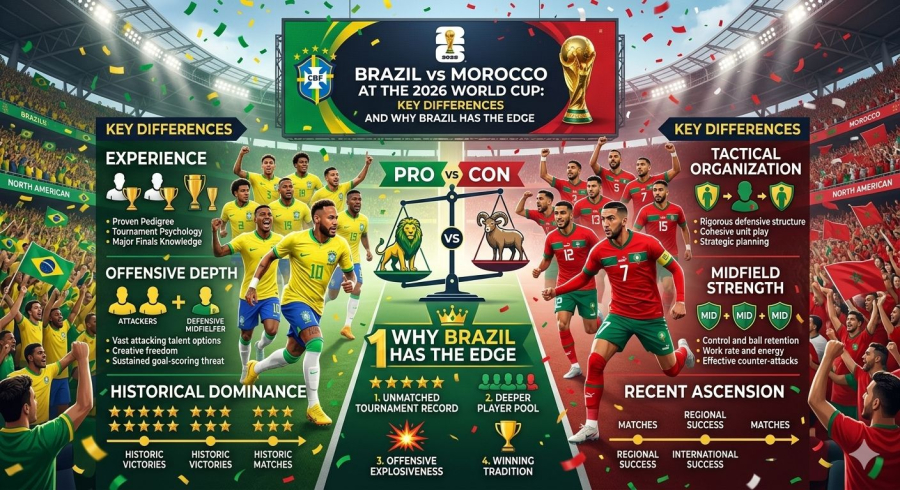
Brazil’s Strengths That Translate Especially Well to World Cup Football
Technical Quality Under Pressure
International games can be chaotic: unpredictable bounces, heavy pressure, and limited time to build club-style chemistry. Brazil’s technical quality has traditionally helped them maintain control in messy phases. Clean first touches, composure in tight spaces, and confidence receiving the ball under pressure can reduce turnovers and keep the team on the front foot.
Ability to Create Chances Without Dominating Possession
Brazil can be dangerous even when they do not control the ball for long stretches. That matters against a team like Morocco, who may be comfortable without heavy possession and may aim to keep Brazil in front of them. Brazil’s ability to strike quickly can punish even small positional errors.
Multiple Threats Across the Front Line
When opponents focus on stopping one primary creator, Brazil often still have other avenues. That forces defenses to stay honest, because overcommitting to one side or one player can open spaces elsewhere. In tournament football, this multi-pronged threat often separates contenders from spoilers.
Morocco’s Strengths That Make Them a Real Test
Collective Discipline and Clarity
Morocco’s success has been powered by collective discipline. Players tend to understand their roles, keep their distances, and defend as a unit. Against teams that rely on improvisation, organization can be a powerful equalizer.
Transitions That Can Hurt Anyone
Morocco can be extremely effective once they win the ball. Quick forward passes, wide outlets, and direct running can force top teams to defend in uncomfortable situations. Even elite sides can be vulnerable for a few seconds after losing possession, and Morocco are well positioned to exploit those windows.
Confidence Built from Proven Giant-Killing
Morocco’s 2022 World Cup performance strengthened their belief that they can compete with the best. That confidence is valuable because it changes decision-making: players take responsibility, make braver runs, and stick to the plan under pressure.
Head-to-Head Style Matchup: Where Brazil Can Tilt the Game
If Brazil want to turn their advantages into goals against a structured opponent, a few tactical themes often matter:
Stretching the Back Line Horizontally
Compact defenses thrive when they can keep everything in front of them. Brazil’s wide play can force Morocco to defend larger distances side-to-side, which can create half-spaces for cutbacks, through balls, and late runs.
Attacking the Space Between Fullback and Center Back
Well-organized teams still have vulnerable seams, especially when they shift across the pitch. Runs into the channels and quick combinations near the corner of the box can create chances without requiring low-percentage shots.
Patience Without Predictability
Against a set block, patience is good, but predictable circulation can actually help the defense. Brazil’s edge often comes when they mix tempo: a few slow possessions to pull the opponent across, then a sudden acceleration with a carry, a third-man run, or a vertical pass.
Comparison Table: Brazil vs Morocco in a World Cup Context
| Category | Brazil | Morocco |
|---|---|---|
| World Cup pedigree | Historically elite; five-time champions; deep tournament experience | Rapidly rising profile; historic 2022 semi-final run |
| Typical identity | Attacking variety, creativity, technical quality | Defensive structure, discipline, efficient transitions |
| Depth across positions | Usually very strong; multiple high-level options | Strong core; depth can vary by position |
| Chance creation | Multiple patterns: wide play, combinations, individual actions | Often selective; focuses on high-value counters and set pieces |
| Match-winner potential | Consistently high due to elite attacking talent pool | Capable, especially in transition; relies more on collective execution |
| Best scenario | Open game with space to exploit and sustained pressure | Tight game state, controlled tempo, defending a lead |
Why Brazil Has the Edge (Without Underestimating Morocco)
Morocco have shown they can stay compact, suffer without collapsing, and strike at key moments. That makes them dangerous against any opponent, including Brazil. But if you’re looking for the clearest reasons Brazil would enter a hypothetical 2026 World Cup meeting with an advantage, three points stand out.
1) More Ways to Win the Same Match
Brazil’s biggest edge is flexibility powered by talent. They can win a match by dominating possession, by countering, by set pieces, or by one moment of brilliance. When a team can win in multiple ways, it becomes harder to game-plan against them.
2) Greater Margin for Error
Morocco’s strength is precision: tight spacing, sharp transitions, and concentrated focus. That approach can absolutely win. But it can also demand near-perfect execution for long stretches. Brazil’s talent and depth often provide a bigger margin for error; even if a few attacks break down, they can generate another wave of pressure and still create decisive chances.
3) Tournament Know-How in Late Stages
If the match is a knockout tie, Brazil’s long history of navigating World Cup pressure can become a real asset. That doesn’t guarantee victory, but it can influence small details: decision-making in extra time, calmness on a final pass, or execution in a tense finish.
What Morocco Can Do to Make It Uncomfortable for Brazil
Even with Brazil holding the edge on paper, Morocco have a clear path to turning the matchup into the kind of game they like:
- Protect central zones and force Brazil wide, then defend crosses aggressively.
- Choose pressing moments carefully to avoid being played through.
- Attack quickly after regains before Brazil can reset their defensive structure.
- Maximize set pieces with well-rehearsed deliveries and second-ball readiness.
If Morocco can keep the score level deep into the game, pressure often shifts to the favorite. In those moments, Morocco’s organization can become even more valuable.
Positive Takeaways for Fans: What Each Team Brings to the 2026 Stage
Brazil: A High-Ceiling Team Built for Big Nights
Brazil’s appeal is timeless: flair, confidence, and an ability to turn matches into moments. For supporters, a Brazil World Cup run is exciting because the ceiling is always championship-high, and the team’s attacking potential can ignite at any time.
Morocco: Proof That Modern Structure Can Compete with Tradition
Morocco represent one of football’s best modern stories: a team that can combine top-level individual professionals with a disciplined collective identity. For fans, Morocco’s rise is compelling because it shows that belief, organization, and unity can challenge the biggest names on the sport’s grandest stage.
Bottom Line: Brazil’s Edge Comes from Depth, Variety, and Big-Moment Tools
If Brazil and Morocco meet at the 2026 World Cup, it would likely be a chess match between Brazil’s attacking variety and Morocco’s defensive control. Morocco have every reason to believe they can compete and potentially spring another high-profile surprise, especially if they can keep the game tight and capitalize on transitions.
Still, Brazil’s edge is rooted in three tournament-ready advantages: more depth, more ways to create and finish chances, and more institutional experience in matches where one moment can define everything. In a World Cup setting where fine margins rule, those qualities are exactly what can push Brazil from “favorite” to “winner.”
FAQ: Brazil vs Morocco at the 2026 World Cup
Is Brazil vs Morocco confirmed for the 2026 World Cup?
No. Matchups depend on qualification outcomes and the tournament draw. This is a forward-looking comparison of styles and strengths that would likely matter if they do meet.
What makes Morocco a difficult opponent for top teams?
Morocco’s compact defensive organization, disciplined positioning, and fast transitions can limit clear chances and punish mistakes—traits that translate well to knockout football.
What gives Brazil the edge in a tight game?
Brazil typically bring more attacking variety and more high-impact options from the bench, plus a long track record of managing big World Cup moments.
What would decide the match most likely?
Key swing factors would likely include the first goal, the effectiveness of Morocco’s transitions, Brazil’s ability to create chances against a set defense, and set-piece execution at both ends.
Note: Because 2026 squads and form will evolve, the most reliable way to use this preview is to focus on stable strengths: Brazil’s depth and attacking variety, and Morocco’s organization and transition threat.
